About

Very few people truly understand the natural world. For example, many folks—from the gardener and homeowner to the scientist—view wildlife as man’s nemesis. But in reality, these organisms exist to make the environment habitable for mankind. Visit this site to learn the truth about “Mother Nature”.

Excerpted from “Do Garden ‘Pests’ Exist”?, which appeared in the March, 2013 edition of the Crozet Gazette.

slugs-eating-dead-tadpole-970310
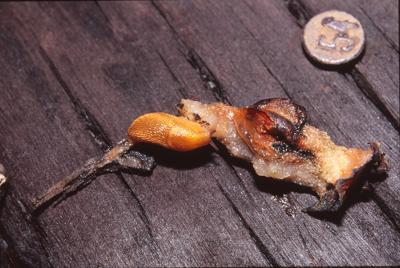
When these 2 slugs feed upon this dead tadpole, they are recycling it. (Photo courtesy Marlene A. Condon)

Most people’s idea of gardening is one that involves a constant war with Mother Nature. Pick up any gardening magazine or book (except my book, The Nature-friendly Garden), watch any gardening show on television or listen to any radio program about gardening, and you will undoubtedly read or hear about “pests.”

This word even appears in scientific papers, meaning that scientists also believe that some organisms exist solely to wreak havoc upon the natural world. But nothing could be further from the truth. In reality, the natural world is all about the perpetuation of life in a world of limited physical space and resources.

The reason people generally don’t recognize this truism is because they tend to look at the world only from their own narrow perspective, rather than in a truly objective manner that reveals the genuine principles of nature.

For example, a few years ago when I had finished giving a slide presentation, an acquaintance in the audience asked why she was having trouble with slugs in her lettuce bed. I had explained in my talk that the preferred food of slugs is rotting plant or animal matter, so I asked her if she had perhaps removed most of the organic material from her yard.

People often do this because they feel they need to “clean up.” But when folks remove plant debris, the slugs have nothing left to feed upon other than the gardener’s healthy plants. However, the woman assured me that she had plenty of organic matter for them to eat.

It can be difficult to figure out why someone is experiencing garden problems without seeing the garden for yourself. Fortunately, I was able to see the lettuce patch in person when I was invited to this lady’s home. I immediately saw why the slugs were there: the lettuce plants had been planted too close together.

From above, the lettuce plants looked crisp and green and gave the impression that all was well, but it actually wasn’t. Because the plants were so crowded, there was no way for air to get underneath them after a rain or a watering so evaporation could occur. Thus the soil and the leaves at the bottom of the plants remained constantly drenched.

As a result, the leaves closest to the ground had begun to rot, attracting slugs whose “job” is to recycle decaying matter back into the environment. In other words, the slugs were not there to feed on the leaves that were doing fine at the top of the plants, but rather to feed upon and get rid of the leaves that were not doing well at the bottom of the plants.

Their actions would help the lettuce plants by giving them a chance to thrive, which they would not otherwise be able to do. In their state of over-crowdedness, the plants were doomed to ultimately end up sickly because their roots would start dying.

As long as the soil remained wet underneath the lettuce plants, the pores (spaces) within the soil structure would be filled with water instead of air. This situation would make it difficult for the roots to get oxygen, which they need for the chemical processes to occur that provide energy for them to grow.

Because the natural world is about perpetuating life, Mother Nature sends in organisms to try to correct problems. In this case, microorganisms had moved in to rot the lower wet leaves so slugs would come to eat them. When the slugs removed the rotting leaves, they would open up space for air to begin circulating around the plants. The air would dry not only the leaves, but also the soil—which is critically important to the well being of most plants.

Thus the slugs were there to try to save, not hurt, the plants! Yet horticulturists refer to slugs as “pests” and advise gardeners to kill them on sight as if they are “bad” animals. Go to any extension web site in the country and you will find this advice, the result of people not possessing a true understanding of how our natural world actually works.

This is a sad situation for numerous reasons, some of which are that:

People are killing innocent animals that are only trying to do their jobs;

People usually kill these innocuous creatures with chemicals that are poisonous or otherwise harmful to humans and other organisms;

When people kill animals, they usually impact numerous other kinds of critters that are dependent upon those animals for food; and

Wildlife provides services that keep the environment functioning properly, so the unnecessary killing of particular animals (such as slugs) negatively impacts the environment.

The reality is that garden “pests” don’t exist, but poor horticultural practices (i.e., those that conflict with the laws of the natural world) do. To be a happy, successful gardener, you must learn to live in agreement with nature. In other words, you and your garden need to be nature-friendly.
November is a Good Time to Give Thanks

©Marlene A. Condon

November 2, 2019

110219_dnr_naturenews

A pretty (yes, it really is!) orange-colored slug feeds upon a discarded apple core, recycling it back into the environment for the benefit of plants. Marlene A. Condon

Thanksgiving is a good time to recognize the efforts of wildlife on our behalf. These organisms perform their good works mostly out of sight of humans, which means people tend to overlook how valuable wildlife is to their own existence upon the Earth. Let’s look at how some of these critters make our world habitable for us.

All life on the Earth is dependent ultimately upon plants. Plants capture the Sun’s rays and transform this energy into a form usable by humans and other animals. But for plants to function well, they must obtain nutrients, air, and water from within the soil. Thanks to ants, earthworms, moles, and various other kinds of animals that move around within the soil, tunnels (pathways) are created that allow air and water to move in between soil particles where roots can access these vital substances.

Nutrients are provided by decomposition of dead plant and animal matter by microorganisms as well as recyclers, such as slugs and snails. Plants also get “natural fertilizer” from animal droppings that are broken down into a usable form for them by dung beetles and the larvae of some kinds of beetles and flies.

Gardening tip: To save time and effort, place dead plant material around your plants instead of putting it into a compost pile. Doing so provides food for slugs and snails, which means they won’t be starving and needing to eat your plants! You’ll be surprised by how quickly this organic matter disappears.

When woody plants die (trees, shrubs, and some kinds of large vines), they, too, must be cycled back into the environment. Woodpeckers help to start the process by making holes in the wood, either while looking for insects that reproduce inside it or by hollowing out cavities in which they can nest. These openings allow fungal spores to enter and grow upon the wood, breaking it down in the process.

Other organisms also help to recycle wood, the best known of which is the termite. Very few organisms can break down wood due to the cellulose that comprises the bulk of its cell walls. This material is so tough that it’s why trees can grow so tall and remain standing. But even the termite cannot digest wood on its own. Its gut contains a diverse population of microorganisms that break down cellulose to provide nutrition to the termite.

Home maintenance tip: Termites feed upon dead wood. Therefore, it’s important to maintain any wood inside and outside your home in good shape. Keep siding painted or stained, and watch for water leaks that start the decay process that invites termites to recycle the wood. They don’t see your home as different from a dead tree.

Dead and decaying animals also must be recycled. Vultures are an especially indispensible part of this process as they feed in a group that quickly removes most of a carcass. Fly larvae (maggots) and carrion beetles help recycle leftovers.

So, this Thanksgiving, please remember to give thanks for our wildlife!

Marlene A. Condon is the author/photographer of The Nature-friendly Garden: Creating a Backyard Haven for Plants, Wildlife, and People (Stackpole Books; information at www.marlenecondon.com). You can reach her at marlenecondon@aol.com

Witch Hats at Halloween

©Marlene A. Condon

October 5, 2019

Witch Hazel Photo

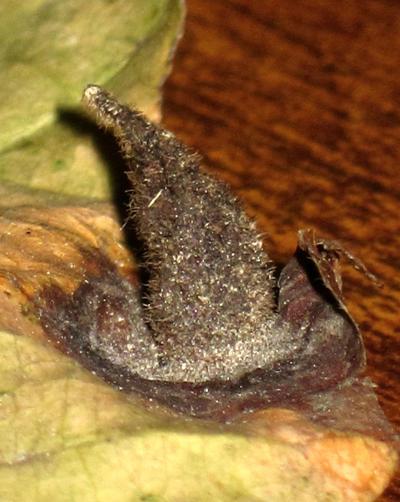
Little dark-brown witches’ hats like this one can be found on the leaves of the native Witch Hazel (Hamamelis virginiana) shrub—just in time for Halloween. Courtesy of Marlene A. Condon

Perhaps nothing is associated more with Halloween than witches who are always pictured as wearing conical black hats. In Virginia this month, you can see what appears to be small (about 3/8-inches tall), blackish witches’ hats on the aging leaves of a common native shrub called (can you believe it?) Witch Hazel (Hamamelis virginiana).

Each “hat” is the result of a miniscule wingless female Witch Hazel Leaf Gall aphid (Hormaphis hamamelidis) that hatched in spring from an egg left upon a branch the previous year. The purplish black, pear-shaped aphid made her way to a leaf bud to feed upon the plant’s sugary juices.

As she fed, she injected chemicals that induced the growing leaf to multiply its cells around her, forming a hollow cone-shaped gall that provided the aphid with a shelter against predators and the weather. Here she fed and produced a new generation of aphids asexually, which means each of her offspring was a clone of its mother.

The witch-hat galls first appear in springtime, colored a bright red that over time turns yellowish green. By fall, the galls are dark brown or black and you can see them by looking closely at the leaves of the Witch Hazel. This plant can often be found growing along rivers and streams, but it is also quite common at higher elevations, such as in Shenandoah National Park and around Mountain Lake, in southwestern Virginia.

Witch Hazel is a garden plant of interest to gardeners because it starts blooming so late in the year, thus adding interest to the landscape after the usual growing season. Come mid-fall, light-yellow strap-like blooms appear, often while the shrub still has its yellowing leaves which tend to hide them. However, once the leaves drop, the blossoms become much more conspicuous.

Some folks might choose to grow Witch Hazel for the medicinal properties of its bark, twigs or leaves. I chose to plant several of these shrubs many years ago specifically to get to see the little witch hats on the leaves. It’s a bit of fantasy brought to life.

Aphids are at the bottom of the food chain, serving as a vital food source for numerous kinds of critters, such as hummingbirds, ladybugs and immature mantids that are so small themselves that they can only catch and eat insects tinier than they are. Witch Hazel Leaf Gall aphids are more vulnerable to predation on their alternate host, the birch tree, where they do not make a gall.

I was thrilled to discover that this shrub easily supports numerous other kinds of insects, such as a very slim caterpillar that pulls a leaf edge over itself that is as neatly folded as a napkin. And just this year, I discovered the Gray Squirrel feeds voraciously upon Witch Hazel seeds.

In the wild, Witch Hazel tends to be an under story plant, growing beneath the canopy of tall trees. But at home, you can grow it in a location that gets full sun to part shade.

Marlene A. Condon is the author/photographer of The Nature-friendly Garden: Creating a Backyard Haven for Plants, Wildlife, and People (Stackpole Books; information at www.marlenecondon.com). You can reach her at marlenecondon@aol.com

The American ‘Canary’

©Marlene A. Condon

September 7, 2019

Nature News Photo

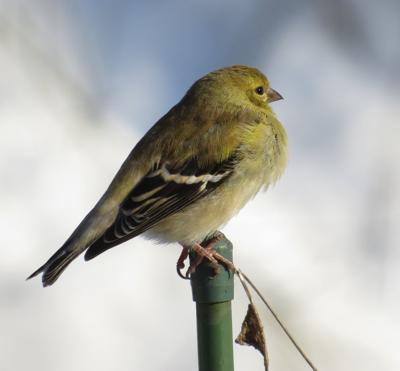
The American Goldfinches you see in late fall and early winter have greenish feathers, rather than the bright-yellow plumage of spring and summer that gives rise to the name, American (or Wild) Canary. Courtesy of Marlene A. Condon

The very first time I heard juvenile American Goldfinches, I didn’t recognize the sounds they were making. Employing binoculars, I located them in a tree, where they were begging their parents to be fed.

You can begin to hear their distinctive “crying” sound about the same time that Common Nighthawks are beginning to migrate south through our area, which is around the middle of August. However, it’s not unusual to first hear the young goldfinches as late as the middle of September.

Why would one bird species have young barely out of the nest at a time when other species are already leaving the area to escape the cold weather that’s coming? The answer is diet. Relying almost entirely upon fresh seeds to feed its young, these bright-yellow birds must wait until a numerous supply exists before reproducing, and that occurs in mid- to late summer.

Another reason for the delayed breeding time is the availability of thistle down (the fluffy filaments that help the seeds to be dispersed by the wind) that these little birds use to line their nests. Some species of thistles (Cirsium spp.) begin to bloom in June and have begun to go to seed by mid- to late July, allowing goldfinches to build their nests and to feed their chicks when they hatch.

Therefore, I love to see thistles growing on my property. People worry that these bristly plants can easily get out of hand and take over, but that is not true in a nature-friendly yard. Because goldfinches eat most of the seeds, very few are available to germinate the next year. I don’t have thistles every year, although I wish I did. The nectar-rich blooms bring in many kinds of butterflies, bees, and other kinds of insects.

Our native thistles are biennial plants that live only two years. The first year an attractive spiral of thorny leaves (a rosette) comes up. The following spring a flower stalk emerges from its center, the plant blooms and disperses its seeds, and then the thistle dies. It’s crucial that these thistles be available if goldfinches are to perpetuate their species.

The thistle most likely to be problematic for humans is the non-native Canada Thistle (Cirsium arvense). It’s perennial and spreads by underground stems (rhizomes) as well as by seed. Thus, it can be more difficult to completely eradicate from an area.

You can identify this plant easily by checking underneath the leaves and along the stalk for white hairs. Canada Thistle is “bare of hair” — my mnemonic poetic device for remembering how to recognize this non-native thistle. If you find a white “felt” of hairs, the plant is probably a biennial native that you should welcome to your yard.

During summer the pinkish-purple flowers of our native thistles will be covered with numerous butterflies and by fall the seed heads will bring in chirping, colorful, wild “canaries”. Now don’t you agree that a thistle or two in the garden is a great addition to the yard? I hope you do!

Marlene A. Condon is the author/photographer of “The Nature-friendly Garden: Creating a Backyard Haven for Plants, Wildlife, and People.” You can reach her at marlenecondon@aol.com and find info on marlenecondon.com.

August Heralds Coming of Cold Weather

©Marlene A. Condon

August 3, 2019

Butterfly photo for nature news

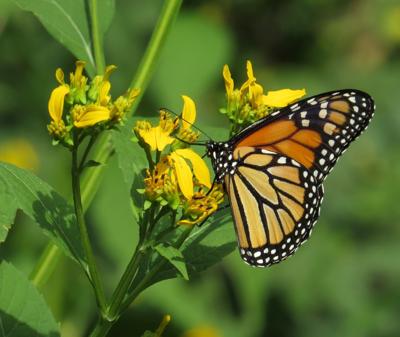
Yellow Crownbeard (Verbesina occidentalis) is a native “weed” that appeared in the author’s garden one year. It has been welcomed ever since because it feeds late-season Monarch butterflies. Courtesy Of Marlene A. Condon

You may think of August as another hot summer month, but for many kinds of critters, it heralds the coming of cold weather and the need to leave for warmer climes. Male Ruby-throated Hummingbirds usually disappear from feeders by the end of this month, and Monarch butterflies start to be seen more often in Virginia as they arrive from farther north.

These two species depend upon flowers for nectar and insects, which is why they are compelled to leave us. Very few plants bloom in winter and insects are, for the most part, not active.

Resident male hummingbirds leave first, followed within a week or so by adult females. Young birds of the year leave last. Most Ruby-throats spend the winter in southern Mexico and Central America, but with this season becoming somewhat warmer on average in recent decades, some hummingbirds are overwintering in states along the Gulf coast.

If you’ve been providing sugar water this summer, it’s a good idea to keep your feeder up throughout the fall. As flowering plants die or go dormant, there is less nectar available for hummingbirds still traveling south from more-northern states. They are sometimes seen as late as October in Virginia. Keeping your feeder out (filled with less sugar water since it won’t get many visitors) is a nice way to make the journey a bit easier for these tiny birds.

Some folks worry that a feeder will keep hummers from leaving, but that’s not the case. Animals that migrate do so when they are physically ready to undertake their long journey southward to escape cold and a dearth of food.

People have started to include milkweeds in their gardens to assist Monarch caterpillars. These plants are especially important throughout the fall months because Monarchs arriving from farther north are mating and laying eggs here. These adults will die, and their offspring will continue the southward journey towards Mexico where eastern U.S. Monarch butterflies overwinter.

If you wish to help Monarchs to reproduce well, the best plant to grow is Common Milkweed (Asclepias syriaca). This native plant grows to about four feet, on average, providing plenty of big leaves for caterpillars to munch on. Additionally, because the plant spreads by underground stems (called rhizomes), it often sends up new shoots late in the season, just in time for migrating Monarchs to lay their eggs where their caterpillars will have fresh green growth to eat.

Another way to assist Monarchs is to grow late-blooming plants that can furnish nectar for adults. Goldenrods (Solidago spp.) and the Common Dandelion (Taraxacum officinale) are perfect, and you may not need to purchase plants if you can leave a bit of bare ground where “weeds” can start to grow. Many of the plants people consider unwanted are not only exceedingly useful to wildlife, but also delightful for people to have in the garden. Goldenrods and dandelions create a sunny, warm glow when their golden and bright yellow blooms, respectively, appear as days are getting shorter and chillier.

Annual Cicadas a Sure Sign of Summer

©Marlene A. Condon

July 6, 2019

Cicada Photo

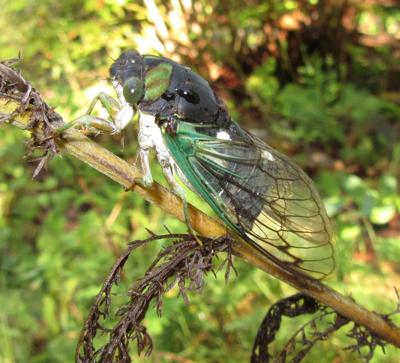
The other-worldly look of the common annual cicada often causes people to overlook the beauty of its unusual coloring. Courtesy of Marlene Condon

When cicadas start “singing” (usually around the middle of June in Virginia, depending upon the weather), you know summer has arrived. These strange-looking insects are heard more often than seen, but if you keep your eyes open, you may be able to spot one or a cast-off skin. They can be found almost anywhere, on both herbaceous plants and woody stems, and even upon manmade structures.

The common cicada in Virginia has a stout, black-and-green body, with clear wings. It’s a big insect, from one-to-two inches in length, with prominent eyes on a wide, blunt head sporting short, bristly antennae.

Males sing to attract mates, but they do not have vocal cords. They create the high-pitched whine that we hear on summer days by vibrating a pair of membranes near the base of the body. The membranes are attached to powerful muscles, which the cicada employs to very rapidly jerk the membranes, causing them to snap in and out.

A male cicada’s job is to provide sperm to as many female cicadas as possible before he dies. After he transfers his sperm to a female, she will use a sharp, spear-like egg-laying tube known as an ovipositor to make slits in numerous twigs. She pushes eggs through the tube into each slit as she makes it, laying perhaps 500 eggs by the time she dies.

The slits are obvious, if you want to look for them on the ends of the live branches of small trees. They are surrounded by fibers along the edges and are not very long. The twigs eventually die and turn brown because the nutrient flow has been severed.

You don’t need to worry about long-term harm to trees. They do not mind a bit of pruning. You can break or knock off the dead twigs, if you don’t like the way they look. However, patience will save you time and energy. The wind will eventually remove the dead twigs, if birds haven’t already done so.

In nature, the actions of one kind of organism are helpful to other kinds of critters. Consider any tree with dead twigs as a “home improvement store” for the numerous kinds of songbirds that need such twigs to build their nests in trees or shrubs. Instead of disliking the cicadas, think instead of how you are assisting birds to reproduce, and you can feel good about those dead twigs.

After the cicada eggs hatch, the immature cicadas — known as nymphs — soon drop off the twigs and search for a crack in the earth. When they find one, they start digging down and disappear to feed upon sap from the roots of trees. Adults also feed upon tree sap above ground.

Nymphs won’t see the light of day again until they emerge as adults in two to five years, despite being called “annual” insects. The reason some cicadas emerge every year is because there are different broods, which don’t all reach maturity at the same time.

Enjoy the summer chorus.

Hello from my Nature-Friendly Garden

©Marlene A. Condon

June 1, 2019

Condon Column Pic June 1

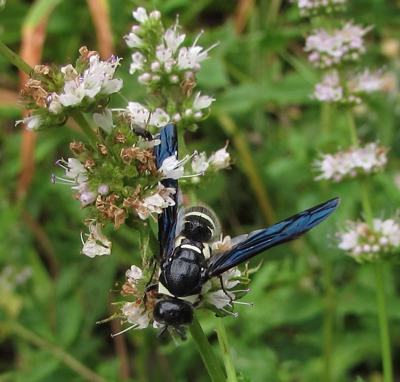
Wasps, such as this mason wasp feeding at mint flowers in the author’s garden, are valuable pollinators. In return for helping plants to reproduce and thus perpetuate their species, the wasp is rewarded with food. Courtesy of Marlene Condon

Welcome to Nature News, a source for learning about the natural world and how to create wildlife habitat around homes, businesses, schools, libraries and churches— anywhere open land exists that is not used much, if at all, by people. Even if you live in an apartment, you can help our wildlife if you have a sunny balcony where you can grow potted flowers.

A United Nations report published on May 6 tells us “about one-third of all species right now in the U.S. are at heightened risk of potential extinction in the next couple of decades.” All of us can help to prevent this situation from happening.

Many of these animals come through our yards during migration (birds) and some could be living there now (frogs and salamanders), if you’ve already landscaped with wildlife in mind. If you haven’t done that yet, don’t worry as I hope to provide tips to make your yard or balcony more welcoming to the critters we should make feel at home around us.

I’ll be sharing the knowledge I’ve gained from closely observing the natural world throughout my life. I’ve been extremely interested in learning about wildlife and wildflowers for as long as I can remember, and have documented my discoveries in print and photographs. By reading this column, I hope you will gain a new understanding of how the natural world works, and I hope, come to value and love it as much as I do.

Our wildlife keeps the environment functioning properly for our benefit, which means your yard and gardens will be much more productive with its help. For example, gardeners think highly of earthworms because they burrow through the soil, which provides aeration (the creation of spaces where plant roots can grow and receive air and water from the surface). But other organisms, such as ants, also perform this job and are equally important to the health of your plants.

You may think of ants as “pests” because we don’t want them inside our homes, but there are steps you can take to prevent that from happening. Another aspect of this column will aim to explain how you can peacefully coexist with our wildlife, such as caulking cracks to deter the entry of ants and other insects and not placing mulch close to the foundation of your house and other structures.

By placing plants a few feet away from buildings instead of very close to them, as is often done, you allow them access to sunlight and rain, and you keep animals attracted to the plants farther away. This limits the opportunity for them to find a way into your residence, especially if they find mulch around the plants a good place to live.

It’s important to recognize the value of organisms to the environment and to learn to coexist with them. It may not always be easy or what you prefer, but we really have no choice if we want the Earth to be healthy and to support us.

Marlene A. Condon is the author/photographer of “The Nature-friendly Garden: Creating a Backyard Haven for Plants, Wildlife, and People.” You can reach her at marlenecondon@aol.com and find info on marlenecondon.com

Dark Skies

©Marlene A. Condon

April 5, 2019


Lights burning in broad daylight waste not only natural resources and your money, but also add pollution to the atmosphere that contributes to global warming. Photo: Marlene A. Condon.

I started my journey to Charlottesville when I was seven. Living in a neighborhood not yet blighted by street lamps, I could spot on clear nights the steady glow of the nearby planets of the Solar System, as well as the moon that had not yet been visited by man. I was able to peer into deep space, observing in the black sky the dense band of stars making up the disk of our own galaxy (the Milky Way), as well as scintillating distant galaxies and nearby stars. These celestial objects so thoroughly enthralled me that I decided at this young age to become an astronomer.

About eighteen years later, as I was working towards my physics degree, I learned of the Summer Student Research Program offered by the National Radio Astronomy Observatory in Charlottesville. Although there were very few assistantships available, I applied. Happily, I was chosen to come here to do research with an astronomer that summer, and the rest—as they say—is history!

The ability to view the night sky when I was very young determined my direction in life. Today the night sky is, for most children, an exercise in futility. They may know it’s out there somewhere, but they are highly unlikely to see much of it from their own back yards, as I was able to do. For them, the night sky exists only in theory.

I moved permanently to the Charlottes-ville area 40 years ago, and over that time I’ve witnessed the decline in one’s ability to view the night sky, thanks to more and more lights sending their rays skyward. From my home in a rural area northwest of Crozet, I see—especially on cloudy nights—a tremendous glow when I look east towards Charlottesville. To the northwest, Harrisonburg can now be located by its glow on the other side of the Blue Ridge Mountains, and the same is true of Waynesboro to the southwest.

The intensity of lights from highly developed areas not only obliterates the sky; it has also made the night itself less dark. I can look out the window, even on moonless nights, and see my husband’s truck in the driveway, as well as the driveway itself! Does any of this matter? Yes, it does, and not only to astronomers trying to view the universe. Night-flying migrating birds need to see the stars in order to navigate to their destinations.

We’ve evolved within a 24-hour rhythm of light and darkness. Mess up that rhythm, and you mess up your bodily life functions right along with it. It’s the reason we have problems adjusting our sleep/wake cycle to other locations when we travel long distances by plane. 

Animals (and plants) are affected by the number of hours of light they get each day. Birds that should be sleeping (all organisms must rest their bodies) stay awake most of the night if they reside in an area with bright lights. I’d always been perplexed by reports of mockingbirds and robins singing all night in developed areas, as this situation didn’t make sense and didn’t agree with my decades of relatively quiet, dark country nights.

Then, one evening many years ago, we visited my father-in-law who had taken ill and was at Augusta Medical Center in Fishersville. As we walked towards the entrance, we had the very strange experience of hearing birds chattering away in the tress that lined the brightly lit sidewalk!

Such birds probably have shortened life spans, just as humans do who spend their lives shortchanged of the requisite number of hours of rest. For night-flying insects, the problem is more severe, with death coming much sooner because of the lights that attract them.

I’ve been writing for years about insects disappearing, and now scientists have found this to be true around the world. They may feel unsure of the cause, but there is no doubt in my mind that the biggest factor is manmade lighting. [See a map of city night lights of the United States, taken from space, at www.flickr.com/photos/wwworks/2712986388]

Abundant night lighting is ubiquitous in the developed world and people don’t think about its consequences, nor do they often care even when they are told how deadly it is to insects—the animals that play the biggest roles in making the Earth habitable for us. The worst aspect of this situation is that so much lighting is excessive and unnecessary.

Parking lots often have at least twice as many light poles than needed for safety. Immensely bright lights at gas stations, and outside restaurants and other businesses, add to the killing glow. Small towns emulate the bigger ones; drive through Crozet at night and the main thoroughfare is bright as day.

And then there are the lights left on all night around homes, and sometimes even barns! Leaving a light on at home occasionally because someone will be arriving after dark makes sense, but often, lights simply burn all night long, night after night.

Insect and spider numbers have dropped precipitously over the past few years. The rainy 2018 season didn’t help. Many insects died and those that didn’t had trouble reproducing.

Consequently, many species of birds last year were not able to nest as many times as usual, and some nestlings died due to a lack of protein and fat they can get only from arthropods. If birds are struggling, you can bet that lizards and salamanders are struggling, along with the animals dependent upon all of these creatures for sustenance.

We cannot afford to treat the dearth of insects and other wildlife the way we have climate change—by not acknowledging it until we face serious crises, such as food shortages. We must start shutting the lights off now.

The obscuration of the night sky by light pollution makes folks lose their perspective, distorting their sense of place in the universe. Perhaps that explains the focus nowadays on everything human.

My book, The Nature-friendly Garden, explained the necessity and benefits of having wildlife in our gardens. The same goes for this country and the entire Earth, the most significant object in the whole universe—that is, until enough wildlife disappears. Because then, we, too, disappear. 


Blue Ridge Naturalist: Dark Skies

Another Form of Bigotry-Human Prejudice Against Wildlife

©Marlene A. Condon

March 5, 2019

When you put out unsecured trash cans, you are responsible for enticing wildlife to create messes. Even worse, you endanger it, because animals sometimes swallow food-scented plastic, which clogs their intestines. Photo: Marlene A. Condon.

Bigotry does not apply just to people’s attitudes towards other people. Defined by Merriam-Webster as “obstinate or intolerant devotion to one’s own opinions and prejudices,” it certainly has a valid connection to the way folks tend to view certain kinds of wildlife.

Although society may still have a long way to go as regards addressing the many forms of prejudice exhibited over the eons by humans towards one another, it can still be said that we’ve come a long way from days of yore. Not so for our attitudes towards wildlife.

The generally accepted negative attitudes towards such animals as rats, bats, coyotes, and raccoons is exemplified by the Virginia Department of Game & Inland Fisheries. No wildlife agency should ever refer to the critters under its watch as “nuisance” animals. Such language further solidifies the bad feelings citizens already hold towards them.

Of course, DGIF is not the only party guilty of implanting unfavorable attitudes about wildlife. We ended 2018 and began 2019 with a local publication writing about rats on the Downtown [Charlottesville] Mall.

The writer made sure to point out that “the term for a group of rats is ‘mischief’,” which was news to me. In all my years of reading and talking with folks, I have never heard anyone use this term, which the writer undoubtedly employed to remind readers that she was speaking of animals likely to cause us trouble. Is this true? Not necessarily.

In real life, wildlife is not much different from the cats and dogs that people most often choose to make their pets. I know, because I had a pet rat when I was young, and he was quite companionable. He was a pretty, black-and-white lab rat that my father found for sale at a pet shop. I already owned white mice (also of the kind used for lab work, I am sad to say), so I guess my father figured I would enjoy a new addition to my menagerie—and I did!

My rat was named Melvin, the name of a friend of my oldest brother, but I don’t really recall now where his moniker came from. What I do remember explicitly is Melvin walking up my arms and onto my shoulders, and never once biting me while being handled.

He was not at all fearsome, and here was the value in my having been given mice and a rat when I was a child: I learned that there was no reason to fear rodents, despite the cartoons that so often depicted people (especially women) up on chairs screaming as a harmless little mouse ran around on the floor. Can you see the silliness of fearing mice to that extent?

But what about rats that are deeply despised in our society? The truth is that they get a bad rap from unusual events that garner biased publicity, and because they can carry diseases to people who attract them with their garbage. 

In the previously mentioned article about Charlottesville Downtown Mall rats, the reporter pointed out that, in a “very unscientific survey” [her words, not mine], “[c]ommonly mentioned problem areas include restaurant patios, tree grates, and garbage pick-up sites.” She didn’t point out that the reason there are rats in these areas is because people view the outside world as a garbage dump.

Sure, it’s an inevitability that folks are going to drop food on the ground near their table when eating outside; accidents happen. But if the person running the restaurant made sure the patio was cleaned at the end of the business day, he or she wouldn’t have rats performing nightly janitorial services. If mall patrons didn’t treat mall grates as unofficial garbage bins, rodents would not be attracted to them either.

As for the official garbage pick-up sites, why not work on reducing the amount of food waste in the first place? It’s a well-known fact that this country throws away an enormous amount of food, much of it from restaurants serving way too much for most people to eat at one sitting. Restaurants don’t need to dispose of more than 50 tons of organic waste every year.(www.turningclockback.com/restaurant-food-waste-facts)

They could offer patrons a choice of meal sizes so each person could order only the amount he knows he’d be able to consume. And when someone asks for mayonnaise, salad dressing, or butter on the side, why does he tend to receive enough for several sandwiches or salads or slices of bread?

The reason it’s so difficult to get folks to implement commonsense suggestions lies in inherent human laziness. It’s a chore to clean inside restaurant premises as required by law; who wants to make the effort to clean the patio outside? When walking along the mall, who wants to bother to carry unwanted food to an official disposal site when you can just throw it into a nearby grate?

When people don’t take responsibility for their actions, our wildlife suffers horribly. The writer of the article on rats suggested a New Year’s Resolution for readers: “Get the city’s rat stats in line with actual rat sightings…when it comes to rats—on the Mall or anywhere else—if you see something, say something.”

I doubt she realizes that she’s advocating for more poisonous bait traps that cause intense agony to animals that don’t deserve to die that way simply because they were doing their job. Yes, rats (and all organisms) have important jobs to do. One of the environmental services provided by these rodents is recycling organic matter back into the soil, ultimately for the benefit of growing plants. If you don’t want rats (and other creatures, such as flies and cockroaches) to perform this task, then people need to do it.

Societal rules must begin to include the demand for composting bins at restaurants and any establishment that sells food. And, of course, individuals need to clean up their act. If you don’t leave waste food lying around, you won’t attract rats and the other organisms that exist to recycle it. It really is quite that simple.

Wildlife shouldn’t be made to suffer inhumane deaths because people don’t live in agreement with nature. It’s time for folks to recognize human prejudice against wildlife for what it is: the last bit of bigotry that has yet to be addressed in society.

Stop falling into the trap of viewing certain animals as “vermin” to be exterminated by government officials or pest-control companies. Look at our world objectively and see wildlife for what it truly is: the cogs in the machine of life that supports mankind. 

The Blue Ridge Naturalist: Another Form of Bigotry— Human Prejudice Against Wildlife

Ecologists Recognizing Value of Alien Plants

              February 11, 2019
Bees and other kinds of insects obtain nourishment from the blooms of Weigela, a spring-blooming shrub native to Asia. Photo: Marlene A. Condon.

Scientists are either waking up to what I’ve been saying for years, or finally becoming brave enough to speak out against the widespread invasive-plant movement. In an opinion piece signed by 19 ecologists in the journal Nature, they argue that “policy and management decisions must take into account the positive effects of many invaders.” (www.macalester.edu/~davis/Nature%20Essay.pdf).

Recognizing that “It is impractical to try to restore ecosystems to some ‘rightful’ historical state,” they go on to point out that eradicating or drastically reducing the abundance of invasive plants is “an impossible goal.” 

Critical thinking is a must for deciding invasive-plant policy to avoid harming wildlife and wasting millions in tax dollars. A situation in California illustrates the foolishness of blindly pushing an agenda without giving any thought to the real-world consequences of doing so.

In the name of “saving” the environment from so-called invasive plants, a movement has sprung up to remove Eucalypt (Eucalyptus globulus) trees from California. These trees, brought in from Australia, now serve as the most frequented overwintering sites for the western Monarch butterfly population. (milliontrees.me/2013/11/01/monarch-butterflies-in-california-need-eucalyptus-trees-for-their-winter-roost/)

Monarchs originally roosted in native conifer stands of Monterey Pine (Pinus radiata), Monterey Cypress (Cupressus maculatum) and Coast Redwood (Sequoia sempevirens). Sadly, extensive development, logging, and poor land-management decisions have reduced the number of these native-tree stands, leaving the butterflies to rely upon non-native Eucalypts.

Ignoring the fact that overwintering Monarchs are very much dependent upon isolated stands of these trees, government plans are mandating removal of them. Does this make environmental sense? Absolutely not; eradication of the Eucalypts means no wintering habitat for Monarchs, which means they will die. 

In other words, this deliberate destruction of habitat is taking place because of ideology, an illustration of the danger posed by people who have been led to believe they are part of an environmentally moral crusade. Native-plant folks out west have managed, as they have here in the East, to convince environmental organizations and government entities at every level that it is a moral imperative to remove plants deemed invasive.

But, the whole point of conservation of the environment is conservation of wildlife, without which the environment cannot function properly. Yet, absolutely no thought is given to how much so-called invasive plants support wildlife or serve important environmental functions in degraded areas. 

Thus, for example, in the city of Waynesboro, the Parks and Rec department decided it had to remove Japanese Knotweed (Fallopia japonica, formerly known as Polygonum cuspidatum) from growing along the South River greenway (Waynesboro News Virginian, March 9, 2018, “War on Weeds”). The main reason given for the removal of these plants was that they are preventing native plants from growing, but this statement is nothing more than invasive-plant folklore that gains credence by the act of repetition.

Read about virtually any “invasive” species and you will find that these plants are typically growing in disturbed areas where man or a weather event destroyed the original soil profile. As a result, the plants that had been growing there previously did not come back because they could not handle the altered physical conditions of the site. It’s why you see so-called invasive plants mainly along roadways, in parks, and along river trails—all areas easily seen by people who then mistakenly believe the exotic plants pushed out native species.

The newspaper stated that knotweed is a “formidable culprit to the river’s health,” but the true threat lies in its removal. This plant has superbly performed erosion control of soil in which native plants struggle to grow, feeds numerous kinds of pollinators when it blooms, and provides wonderful cover and nesting sites for numerous species of birds and the non-herbivorous insects that feed them. One need only to walk the trail with open eyes and an open mind to ascertain the truth of this statement.

Additionally, park employees would use herbicides to kill the knotweed. How can poisoning the Earth be less harmful than allowing alien plants to grow in areas where they are currently the most suited to thrive and thus provide badly needed habitat for wildlife? 

You might wonder how the invasive-plant movement became so entrenched in environmental and governmental circles. The answer lies in the treatment of it as a moral cause in which those who agree with removing “bad” plants are virtuous; those who disagree must be bad like the plants themselves. Under these circumstances, it is difficult for folks to take a stand in opposition; no one wants to be considered immoral.

However, this undertaking is deeply flawed. Rather than critically analyzing each situation and dealing with it in the most appropriate manner, plant nativists (people who practice a policy of favoring native plants over nonnative) take the approach that demands removal of every plant designated as “invasive,” no matter what function it is fulfilling in the local environment or how well it fills what would be an otherwise empty ecological niche.

Earlier this year, for example, someone removed a Leatherleaf Mahonia (Mahonia bealei) that was growing in a swath of red dirt along the road where I exercise. It was one of the few plants that had survived the highway department’s installation of a new guardrail. No native plants had been able to grow in the poor, dry soil exposed a few years earlier by construction, leaving an area several feet wide and long mostly devoid of plants to assist wildlife.

The Mahonia (a native of China) would have provided a very early source of nectar desperately needed by the first pollinators to become active in spring at a time when native plants in bloom are very few. Its fruits would later feed birds, such as Cedar Waxwings and American Robins. Now, not much exists in this area to feed either insects or birds, making the land a wasted resource.

Native or not, plants provide habitat, whereas bare ground does not. Nativists disregard the reality that native plants struggle to survive under the adverse conditions of road salt, mowing, drought, and disturbed, compacted and depleted soil. They would do better by the environment if, instead of pulling and pesticiding, they focused on eliminating the actual causes of alien-plant spread. 

Removing the Mahonia near the bridge resulted in no benefit to the environment, whereas it very much negatively impacted ease of survival for many insects and birds. And in California, removing Eucalypts may well doom the wintering Monarch butterfly population. 

Blue Ridge Naturalist: Ecologists Recognizing Value of Alien Plants