Tips to Make Your Garden More Nature Friendly

Daily News-Record, May 6, 2022

050722_dnr_NatureNews
To attract the lovely Red Admiral butterfly (seen here), you should grow False Nettle (Boehmeria cylindrica) for its caterpillars.Nature News | Marlene A. Condon

“Green” gardening means growing plants for beauty and food in a manner that works with, rather than against, Mother Nature. My yard teems with numerous kinds of plants, but best of all, it’s alive with a fascinating array of critters. Contrary to common “wisdom,” a landscape full of wildlife is a landscape that is healthy — and that’s why it’s smart to model our landscapes upon Mother Nature’s example.

Thanks to natural controls instead of pesticides, my former 2,000-square-foot garden (I can no longer tend such a large garden due to rheumatoid arthritis) always produced enough fruits and veggies each year to personally use fresh and to share with friends and neighbors, and I was able to preserve the extra bounty by canning and freezing. My half-acre yard still blooms from spring to fall with hundreds of kinds of flowers, vines and wild grasses, as well as flowering shrubs and trees instead of lawn.

Establishing a nature-friendly garden is easy. Follow my tips this month and next if you wish to be led down the proper garden path!

Minimize lawn to minimize resource (oil) depletion and to lessen the amount of air, water, soil, and noise pollution. Retain only the amount you will use for socializing and/or for children to play upon.

Replace unnecessary lawn with nectar- and pollen-producing plants that attract a variety of critters, and research which plants provide good cover and nesting sites for birds and other animals. Visit a natural area where you can observe and identify plants being used by wildlife.

If your area is overpopulated by deer, you’ll need to include some nonnative plants that these hoofed mammals won’t eat. Choose alien plants that can feed and/or shelter wildlife.

Plan to grow three levels of plants, if possible: a short level of herbaceous flowers and grasses; a mid-level of shrubs and small trees; and a tall level of very large shrubs and trees.

Site plants properly. Plants provide wildlife habitat, but to do this well, they must be situated in an appropriate location. Be certain the criteria (amount of sunlight, water, and soil texture) for a plant are met where you want to grow it.

Plan to grow “weeds.” This terminology disparages perfectly good plants that aid wildlife and can be quite attractive in the homeowner’s garden. Consider them “volunteers” and allow them to remain in your garden where they can mature so you can identify them and observe the critters that use them. I discovered that the caterpillar of the Red Admiral butterfly made use of False Nettle (Boehmeria cylindrica) when other people (including entomologists) were still thinking you needed to grow Stinging Nettle (Urtica dioica) for it. [American Butterflies, Winter 1995]

Don’t sweat the inconsequential stuff. Natural gardens do not look like plastic perfection. Expect small holes in leaves (plants are not harmed by this), insects wandering around on your plants (many are looking to feed upon other insects), and even some curled leaves (some insects wrap themselves up for protection from predators).

(To be continued June 4)

Marlene A. Condon is the author/photographer of The Nature-friendly Garden: Creating a Backyard Haven for Plants, Wildlife, and People (Stackpole Books; information at www.marlenecondon.com). You can read her blog at https://InDefenseofNature.blogspot.com

Landscaping for Wildlife with Native Vines

Daily News-Record, April 2, 2022

040222_dnr_NatureNews
Trumpet Creeper cultivars are sold that produce a true-red flower instead of the orangey red color of our native vine, but they feed wildlife just as well.Nature News | Marlene A. Condon  

Some native vines that provide food as well as shelter and nesting sites for wildlife are Trumpet Creeper (Campsis radicans), Virginia Creeper (Parthenocissus quinquefolia), and Common Greenbriar (Smilax rotundifolia).

All three of these sun-loving plants are considered by many folks to be uncontrollable “weeds”, but none of them are difficult to limit. The alert gardener who does not want a plethora of vines simply needs to pull out the few seedlings that come up each year. Just as with any other kind of plant, these vines “take over” only after several years of ignoring them in the landscape.

Common Greenbriar is a plant that you want to grow in a corner or area of the yard where no one might brush against it. It has barbs that can scratch you, but therein lies part of its usefulness to wildlife. A fox (or cat or dog) chasing a rabbit will undoubtedly be brought to a halt if its prey runs under a greenbriar thicket. Birds often nest here, and the bluish-black berries that this vine produces are consumed by songbirds and mammals during the winter.

You could start a Common Greenbriar vine from fruits, or you could hope one appears in your yard on its own in the right place! Years ago, I encouraged volunteer greenbriar along my driveway and the thicket is quite attractive with its leathery but glossy green leaves.

I love Virginia Creeper because of its beautiful fall foliage that is my favorite color—red. The palmately compound foliage makes this vine extremely attractive growing up a tree trunk. The flower is inconspicuous but produces a bluish-black berry on a bright red stem that’s visible in early fall. Small mammals and many species of songbirds eat it.

Virginia Creeper often shows up in yards on its own (well, with the help of the animals that eat its berries), but it can also be bought from nursery catalogs. They transplant okay except they are sort of slow to really take off. When Virginia Creeper does start to grow well, it can reach over 35 feet (10 meters).

Trumpet Creeper is the best all-around native vine for the yard. It produces pinnately compound leaves and tubular orangey-red flowers that look great from late-spring until fall arrives. Besides increasing the beauty of your yard, Trumpet Creeper provides nectar for Ruby-throated Hummingbirds and seeds for Tufted Titmice, American Goldfinches, and Dark-eyed Juncos. I’ve even seen titmice storing shelled sunflower seeds from my feeders in its hollow dried stems!

Trumpet Creeper requires lots of room as it can grow more than 35 feet (10 meters) long. You must tie the vine to the structure on which you want it to grow until its rootlets attach to the support. I trained mine to climb up the trellising at the south end of my deck and it spills over the deck railing and onto the floor.

Older stems become woody with age. As a result, the vine eventually supports itself and you can untie it.

Marlene A. Condon is the author/photographer of The Nature-friendly Garden: Creating a Backyard Haven for Plants, Wildlife, and People (Stackpole Books; information at www.marlenecondon.com). You can read her blog at https://InDefenseofNature.blogspot.com

Drought Gardening

Daily News-Record, March 5, 2022

Golf courses such as Pete Dye River Course in Radford, maintain turf short and dense to allow golf balls to “float” upon, rather than sink into, the grass. There’s no legitimate reason for a lawn to resemble a golf course.Nature News | Marlene A. Condon

The spring-into-summer drought of 2021 is the worst I can remember in my 45 years of living in Virginia. Let’s hope we will not experience a repeat this year, but gardeners should garden every year as if there were going to be a drought. 

Water is a precious resource that is too often taken for granted. Whether you get your water from a well or out of a municipal system, it must come from rainfall that has either collected underground or behind a dam. Rainfall is always variable and we should treat it as the unknown quantity it is. Wells can run dry and reservoirs can be depleted.

With that in mind, you can reduce your demands upon the system by always avoiding unnecessary use of water. For example, lawn sprinklers should not run when rainfall is sparse. A green sward is not more important than the availability of water for drinking, cooking, bathing, etc.

Unfortunately, many people fear brown grass means dead grass and they don’t want to go through the effort of reseeding a lawn. However, the grass is not dying; it is simply going into a dormant (inactive) state. As soon as rains return, new green blades will sprout.

You can keep your lawn green longer by not cutting grass before it has grown three inches tall. Longer blades shade the ground, keeping grass roots cooler and slowing evaporation of water from the soil.

Of course, many plants don’t go dormant when there’s a lack of precipitation. Flowers, vegetables, fruiting vines, and newly planted shrubs and trees need water on a regular basis or they really will die.

Most plants are composed of 90% water so they suffer if they give off more of this vital fluid through their leaves than they take in through their roots. Savvy and conservation-minded gardeners know how to help their plants maintain constant moisture levels: They mulch.

To mulch is to place a blanket of material at the base of plants. Organic matter of any sort — seedless hay or straw, leaves, pine needles, wood chips, shredded bark, and newspapers — adds nutrients and tilth (crumbliness) to the soil as it decomposes. Use whatever is easiest for you to obtain.

Mulching reduces the evaporation of moisture, insulates the soil to reduce temperature fluctuations that could be harmful to roots, and it prevents a hard soil crust from forming. These crusts, which tend to form on the clayey soils that are prevalent in much of Virginia, inhibit water absorption and permit wasteful runoff.

Once the soil has warmed in spring and there has been a good rain, place the material as close to your plants as possible without touching the stems. Stems that remain constantly wet will rot.

Do not water unless your plants truly need it. Plants often wilt temporarily in the heat of the afternoon sun, but they should recover nicely by late evening or the next morning. If they do not perk up by morning, give them a slow deep watering.

Marlene A. Condon is the author/photographer of The Nature-friendly Garden: Creating a Backyard Haven for Plants, Wildlife, and People (Stackpole Books; information at www.marlenecondon.com). You can read her blog at https://InDefenseofNature.blogspot.com
Overwintering Insect Eggs

Nature News | Marlene A. Condon February 5, 2022

ARTICLE PIC-02052022-PRAYING MANTIS EGG MASS--IMG_3654adjfinal
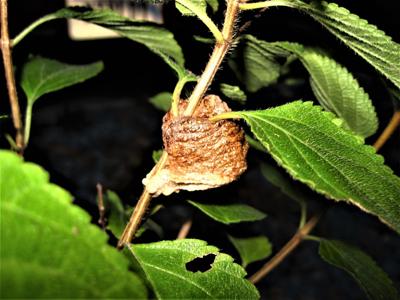
The female praying mantis lays her egg cases from late summer into fall. The young develop inside the hardened foamy mass over the winter months, unless predated by birds or small rodents. Nature News | Marlene A. Condon 

Have you ever wondered where insects go in winter? Many kinds get through the cold months as eggs, some of which you may be able to find.

Adult females lay eggs before dying, and a new generation then awaits warm weather so that it can hatch out. Some eggs may be just about impossible for humans to find because they are so tiny and well hidden. An example would be walkingstick eggs.

An adult female drops them from tree level to the ground in late fall. The eggs are minuscule and become covered by leaves, or at least that’s what’s supposed to happen. Rake the leaves to send to the landfill or burn, and you destroy your walkingsticks. Thus, whenever possible, leaves should be left in place to serve as the natural mulch Mother Nature intended them to be.

Other insect eggs are much easier to spot because the female keeps them together in a casing of some sort. The praying mantis is one such example. As the female lays the eggs, she also secretes a foamy material that envelops them. When she’s done, the covering dries and looks just like meringue! This egg case, whose shape sometimes reminds me of a distorted church bell, contains about 200 eggs.

Although these egg cases are usually attached to flower stems or to twigs of bushes or small trees, you might find them almost anywhere. One fall day I noticed a praying mantis just after she had laid eggs at the top of a window frame on my porch. Later I was luckier and chanced upon a mantis in the process of laying eggs on the light fixture by my cellar door. I was delighted because I had never witnessed this before and I had wondered how the unusually shaped egg cases were made. The female simply moves her abdomen (this is where her egg-laying apparatus is located) in a circular motion, just as is indicated by the swirls that are visible on the bottom of dried egg cases.

Egg cases come in a variety of shapes and sizes, and you can locate some of them by using clues. The familiar Eastern Tent Caterpillars (that mature into moths) especially love apple and wild cherry trees, and their summer webbing or “tents” are often visible on these trees even now. If you check the smaller twigs of such trees, you will probably locate an egg mass. The egg mass can be up to 19mm (about ¾ inches) long and will encircle a stem (the shape reminds me of a corndog!). It will be hard, shiny, and very black. If you look closely, you will see it looks foamy, which is exactly what it was before it dried. There are between 150 and 350 eggs encased in that water- and cold-proof material.

It’s fun to look for insect eggs, but please, do leave them in place. Many of our insect species are dwindling in number so we shouldn’t interfere in order to perpetuate life.

New Year’s Resolutions To Help Wildlife

Nature News | Marlene A. Condon January 1, 2022

123121_dnr_NatureNews
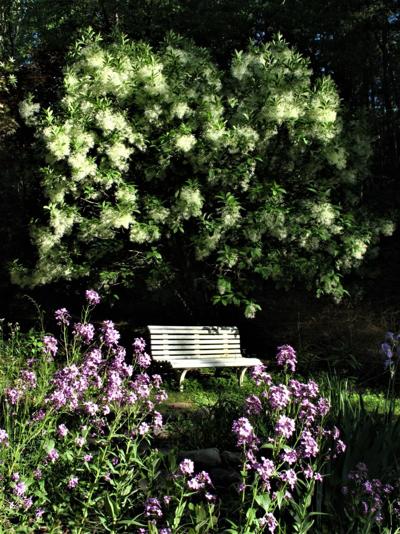
The author planted the Virginia Fringe tree (Chionanthus virginicus) near the bench, but the Dames Rocket (Hesperis matronalis) in the foreground showed up on its own. Whereas others may have seen a “weed”, she saw a wonderful wildlife plant for pollinators and birds. Sadly, this biennial wildflower eventually disappeared from her yard. Nature News | Marlene A. Condon 

New Year’s Resolutions To Help Wildlife

This year, how about making some New Year’s resolutions to help wildlife? Please consider the following options when managing your property.

Limit the amount of lawn around your home. A lawn doesn’t provide as much to wildlife as a variety of herbaceous plants, shrubs and trees. And people’s desire to keep it weed-free (pesticides), dark green (fertilizers) and short (lawn mowers and weed-eaters) creates pollution in the environment.

Plant more trees, shrubs, vines, wild grasses and/or flowers. Learn about plants that are beneficial to wildlife and grow them to provide food and shelter for animals — and beauty for you!

Learn about wildlife so you will be less afraid and more willing to share your property with it. Knowledge goes a long way to reducing prejudice and fear. For example, many people are terrified of snakes and spiders for no real reason and tend to kill these animals on sight, but it’s a shame to take a life when there’s no substantial cause for doing so. Learn about snakes and spiders to understand the role they play in our world and how tiny a threat they pose to humans.

Let some “weeds” grow. Wild plants are typically considered “weeds,” but many produce beautiful flowers that are also useful to our native animals. If such plants come up in a spot where you can let them grow to maturity, you can broaden your knowledge of plants by identifying them and watching which animals make use of them.

Let your flowers go to seed and leave them standing throughout the fall and winter and into the spring. Allowing seedheads to remain on your annuals and perennials is an easy way to provide food for birds and small mammals. It also allows your plants to possibly reseed themselves, saving you some gardening effort in the spring. Chop up the dried stalks and leave them where they fall as the growing season begins. The stalks will decompose and add nutrients to the soil, reducing your need for fertilizer.

If you can, provide water for wildlife. This can be as simple as placing a dish of fresh water out daily for drinking purposes (if the dish is less than two inches deep, birds will also bathe in it). Or you can install an artificial pond that will provide an egg-laying site (and maybe a home) for frogs, toads, salamanders, newts, dragonflies and many other kinds of insects. Even a pond as small as three feet by four feet will be home to many, many animals.

Keep your pets (cats and dogs) restrained so they cannot kill wildlife. Pets take a huge toll on all kinds of wildlife, either directly by killing or indirectly by changing an animal’s behavior (such as preventing an adult bird from returning to her nest of eggs).

It is becoming ever harder for wild animals, and even some plants, to coexist with us. I hope that you will do whatever you can to accommodate our wildlife.

Thank you, and Happy New Year!

Legend Of The Christmas Spider

Nature News | Marlene A. Condon December 4, 2021

120421_dnr_Tree
A 2018 Christmas exhibit at the Glencoe Mansion Museum and Gallery in Radford showcased a Christmas tree decorated with tinsel. Nature News | Marlene A. Condon 

The glittering tinsel that we call “icicles” was first made and sold in Nuremberg, Germany, in 1878. Thin strips of silver foil were designed to “drip” like icicles from decorated Christmas trees. Americans immediately fell in love with this novelty, which was still a popular holiday decoration as I was growing up. Herewith a fanciful tale I came across years ago of how tinsel came to be.

Long ago, a German mother was busily cleaning her home for Christmas. The spiders in the house fled upstairs to the attic to escape her broom. When the house became quiet, they slowly crept downstairs for a peek.

Oh! What a beautiful tree they saw! In their excitement they scurried up the trunk of the tree and out along each branch. They were filled with happiness as they climbed amongst the glittering beauty. But alas! By the time they were through climbing, the tree was completely shrouded in their dusty gray spider webbing.

When Santa Claus came with gifts for the children and saw the tree covered with spider webs, he smiled as he saw how happy the spiders were. But Santa knew how heartbroken the mother would be if she saw her wonderfully decorated Christmas tree covered with dusty webs. So, Santa turned the webs into silver and gold.

The tree sparkled and shimmered and was even more beautiful than before. And that is why we have tinsel on our tree, and every tree should have a Christmas spider in its branches.

Spiders are not actually responsible for Christmas tinsel, but a group of these arachnids are referred to as “cobweb spiders,” or “orb weavers.” They are responsible for most of the webs that we see in our gardens and homes.

A cobweb spider is one of the few kinds of animals that builds a trap to catch its prey. The spider starts by making a framework of strong non-sticky threads that it firmly attaches to surrounding plants or other structures, such as might be found in your house.

The spider adds spokes that radiate from the center of the framework; at this stage the web looks much like a bicycle wheel, but it’s not necessarily round. Then the spider spins a sticky spiral of thread that it attaches to each “spoke” as it circles around in widening arcs from the center of the web. This spiral contains the strands of silk that will catch a meal for the spider to eat, and even the spider itself if it doesn’t avoid those sticky spirals.

Webs last long enough to get dusty inside houses because the silk is coated with a layer of antibiotic to ward off bacterial and fungal decay. Cobwebs may appear untidy and embarrass the proud homeowner, but these structures limit the numbers of critters wandering around inside our houses.

Therefore, I hope that the next time that you need to wipe up a dusty cobweb, you won’t think so badly of the spider that made it. Happy holidays, everyone!

A Basic Bird-Feeding Program

Nature News | Marlene A. Condon Nov 5, 2021

110621_dnr_NatureNewsbirds
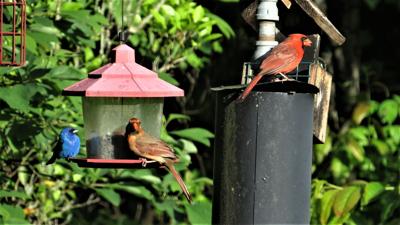
If you provide seeds into spring, you could see the amazingly deep-blue male Indigo Bunting (seen here in the company of a pair of Northern Cardinals). Nature News | Marlene A. Condon 

White millet and sunflower seeds are really all you need for a bird-feeding program, but you must offer these two kinds of seeds separately in the proper types of feeders.

Two varieties of millet (also referred to as proso millet) are often put into seed mixtures: white and red. Red millet is not eaten much by birds in the eastern part of the United States (birds in the West do have different preferences), which is why it’s best to purchase white millet individually packaged. Serve it to ground-feeding birds either in a tray feeder or directly on the ground (but not where cats are around, please, and only put out as much as will be taken by birds that day).

There are also two varieties of sunflower seeds: black oil and striped. Black oil is smaller and might be easier for some birds to eat. Its high oil content provides lots of energy. Striped sunflower seed is larger but has less oil content. Birds with beaks capable of cracking the shell will readily eat this seed, but it is not nearly so popular as black oil.

You can offer the striped, especially if it is less expensive and you want to save money, but black oil is the superior seed. You might see what are called “blended” sunflower seed mixtures consisting of both kinds of sunflower seeds, and if the price is right, you could buy such a mix.

Some species of birds (such as Carolina Wrens) do not have beaks capable of breaking open sunflower seed shells. Such birds can only eat sunflower seeds which are already cracked enough for them to be able to pry the shell off or sunflower seeds already hulled (stores that sell these refer to them as sunflower chips, pieces, or hearts).

Hulled sunflower seeds are attractive to virtually all species of birds, even those that eat white millet (although Brown-headed Cowbirds are unusual in that they seem to prefer the millet). These seeds are more expensive per pound, but you are paying only for edible food, and not for inedible shells. I highly recommend them for feeding areas where you do not want shell litter under the feeder or numerous sunflower seedlings when spring arrives.

Other kinds of seeds are attractive to birds, but may be more expensive, such as niger (or nyger, from Nigeria and pronounced NYE-jerr). It’s very enticing to American Goldfinches, Mourning Doves, and Pine Siskins. You might think of niger as a special treat that you do not need to put out all the time.

Most folks buy a nyger feeder with tiny holes that is especially made to dispense these seeds that are very thin. I have found, however, that any tube feeder will work. What looks like fallen seeds below the feeder are, upon close inspection, simply the discarded shells. The birds do not swallow the entire seed but instead crack it open to eat what’s inside.

For a much closer view of birds, try feeding them.

Dressed For Halloween — Day-Flying Buck Moths

Nature News | Marlene A. Condon October 2, 2021

  • Nature News | Marlene A. Condon
  • 5 hrs ago
  •  0
100221_dnr_BuckMoth
A Buck Moth takes a break from its frantic search for a female. These late-season insects need to mate before cold weather arrives. Nature News | Marlene A. Condon

One fall afternoon, as I was sitting on my front-porch swing, a large white-and-black insect went zipping by. I knew that it was either a moth or a butterfly, but it flew so fast that I couldn’t get a good look at it before it disappeared.

Since I’d seen this insect in the early afternoon, I made sure to be outside again the next afternoon in case it came by. I’d learned long before that animals are often creatures of habit, so if you see one at a certain time of the day or night, you are quite likely to see it again about that same time on the next day or night.

Sure enough, one of these insects came zooming by, flying around in every direction as if it were on its way to a fire but did not know the most direct route to get there! This time I was ready.

While many people interested in moths and butterflies use nets to catch and then observe them, I prefer to leave animals alone, so I was not waiting with a net. Instead, I was waiting with sneakers on my feet in place of sandals so that I could more easily follow (running, if necessary) after the insect as it flew rapidly around the yard.

And fly it did, never stopping at a flower for nectar as some moths and butterflies might do. However, it did land on a leaf, just long enough for me to get the glimpse I needed for identification purposes. It was a moth.

I could see its wings were folded on top of its back; butterflies often close their wings high above their backs but they can’t fold them. This insect had a furry body whereas butterflies do not, and it didn’t have knobby antennae the way all butterflies do.

The moth was mostly black with a white band through the center of each of its four wings that included a black spot. I immediately looked through my field guide to moths (Eastern Moths by Charles V. Covell, Jr.) and found what I was looking for — a Buck Moth. These insects are searching for mates.

The caterpillar of the Buck Moth eats oak leaves, so if you have oak trees around, you may catch a glimpse of this insect any time between now and the middle of November, assuming the weather is not too cold. There are few day-flying moths, especially at this time of the year, and this one is distinctive due to its rapid flight.

I’ve seen Buck Moths flying early in the morning as well as late in the afternoon. Search early in the morning while it’s cool and you may find one at rest, but not necessarily on a plant. Many years ago, I got several photos of one on my trash can in the carport and was able to see that its black body is punctuated with bright orange markings. The colors are certainly appropriate for the Halloween season!

Why Did The Woolly Bear Cross The Road?

Nature News | Marlene A. Condon September 4, 2021

090421_dnr_WoolyBear
Woolly Bears can be found almost anywhere. Here one rests on a rock by the author’s artificial pond. Nature News | Marlene A. Condon 

One October day in 1996, I attended an outdoors writers’ meeting in Warrenton. As I drove from Crozet early that morning, I saw hundreds, if not thousands, of Woolly Bear caterpillars on the roads. As fall begins, these furry reddish brown and black caterpillars become a familiar sight in Virginia.

You might spot Woolly Bears in summer feeding upon many kinds of wild flowers, grasses and trees. But most people notice their presence only when they see caterpillars crossing roads during September and October. Have you ever asked yourself “Why did the Woolly Bear cross the road?” It’s not “To get to the other side,” but rather “To find a good place to hibernate.”

As summer ends, many caterpillar species encase themselves in a protective covering and undergo internal changes to become adults, a process called pupation. Woolly Bears, however, spend the winter in larval form and do not pupate until spring. Therefore, they need to find a sheltered area where they will be hidden from predators and severe weather.

You might find Woolly Bears curled up under mulch or rocks in your garden, or in your basement if they found a way in. Once, when there was a threat of frost overnight, I covered some potted plants with “row cover,” a lightweight fabric used to protect plants from the cold. When I uncovered the pots the next morning, I discovered a Woolly Bear had apparently found the blanket to its liking and had spent the night curled up under it. It soon left to find a more permanent refuge.

The fall Woolly Bears are the second generation or brood of the summer. The first-generation caterpillars (the offspring of the moths that emerged from the caterpillars that had hibernated) pupated earlier in the season. After about two weeks, adults emerged, mated and laid eggs on the variety of plants Woolly Bear caterpillars feed upon until the coolness of fall prods them into finding shelter for the winter. Folks tend to notice them on the move.

The Woolly Bear is the immature form of the Isabella tiger moth that is active during summer nights. You might see one around an outdoor lamp or perhaps at the window of a lighted room. It is not a particularly eye-catching moth, with its two-inch orange-to-brownish-yellow wings that display faint markings. You probably wouldn’t pay much attention to it if you saw one.

Another name for this tiger moth caterpillar is the Banded Woolly Bear because it usually sports three bands of color: Two black ends and a middle section of reddish-brown. Folklore tells us that the greater the amount of black, the worse the coming winter is going to be, but instead, it’s an indication of a caterpillar’s age. Older caterpillars have less black and more reddish-brown.

The Woolly Bear is not as common a fall sight as it once was. Therefore, you might try to avoid running over this harbinger of winter, but only if it’s safe to do so.

Don’t Fear A Snake In The Grass!

Nature News | Marlene A. Condon August 7, 2021 

Snake
Black rat snakes are adept at climbing up wood, whether it be the branch of a shrub (as seen here with mountain laurel) or the cedar siding of a house. Marlene A. Condon 

One day as I pulled out plants growing underneath my bottlebrush buckeye (Aesculus parviflora), I looked up and discovered a large black rat snake resting directly above me on a branch, only inches from my head. I immediately backed out from under the bush and ran — not because I was scared, but because I was excited to have an opportunity to photograph this animal and I needed to get my camera!

Sadly, many folks would have run instead for something with which they could kill the serpent. It’s unfortunate that man’s seemingly inborn fear of snakes results in many of these animals dying needlessly. Snakes are not as dangerous as people think. As with all wild animals, they should simply be shown respect. Don’t mess with them, and they won’t mess with you.

Because snakes are much smaller than humans, they are bound to be the losers in a combative encounter. As a result, snakes would much rather slither away than interact with people, and that is exactly what they will do if given the chance. (If they have just eaten a big meal, however, they may have to stay put to digest it first.)

Black rat snakes are one of our most abundant snakes. Adults are usually black on top and off-white underneath, although juveniles have conspicuous blotches. The chin and throat areas are white or cream-colored. Black rat snakes can grow up to 6 feet long, making them one of our largest snakes. They are not venomous, killing their prey by constricting (squeezing) an animal until it suffocates.

The black rat snake, as its name implies, feeds mostly upon rats and mice. However, this species is an excellent climber and will also make a meal of birds and their eggs.

Folks don’t like to see eggs or chicks taken from bird nests, whether by snakes or other kinds of predators, but it’s important to recognize that this activity must occur. If all the eggs survived to produce chicks, and all the chicks survived to adulthood, the natural world would become overcrowded. There simply isn’t enough space or food for every animal given life each year to survive.

That said, you shouldn’t entice birds to nest in locations easily accessible to predators. Use baffles for bird boxes on poles and make sure the house is properly made so your birds have a lower probability of being taken by a predator. But if they do get taken, don’t begrudge the predator its meal; try to remember it is simply doing its job.

You can live safely among snakes by employing common sense. The most important rule to learn — preferably when young, but it’s never too late to learn — is to never, ever stick your hands or feet into places where you can’t see what’s there. And, pay attention when walking so you don’t step on a snake resting in the pathway.

Please keep in mind that snakes are intriguing animals just doing their part to keep our environment functioning properly.